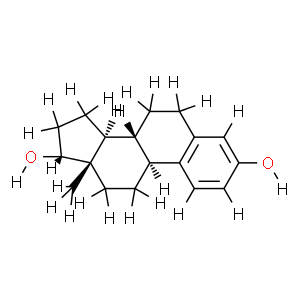
17α-Estradiol (also known as 17α-E2, 17-epiestradiol, alfatradiol, or estra-1,3,5(10)-triene-3,17α-diol) is a minor and weak endogenous steroidal estrogen that is related to 17β-estradiol (better known simply as estradiol). It is the C17 epimer of estradiol. It has approximately 100-fold lower estrogenic potency than 17β-estradiol. The compound shows preferential affinity for the ERα over the ERβ. Although 17α-estradiol is far weaker than 17β-estradiol as an agonist of the nuclear estrogen receptors, it has been found to bind to and activate the brain-expressed ER-X with a greater potency than that of 17β-estradiol, suggesting that it may be the predominant endogenous ligand for the receptor.
Biosynthesis
17α-Estradiol is produced from epitestosterone by aromatase at locations not fully characterized (known to include the brain). Where and how epitestosterone is made is not fully understood. Conversion between 17α-estradiol and estrone seems to occur, but the enzymes remain unidentified.
Occurrence
17α-E2 is found in mice brain, regardless of age and sex, at concentrations much higher than 17β-E2. Gonadectomized and/or adrenalectomized mice continue to have high brain levels of 17α-E2.
17α-E2 poorly binds α-fetoprotein, unlike 17β-E2.
17α-E2 is excreted in urine. It was initially discovered in pregnant mare urine (see conjugated estrogens). In a 2022 study, all six tested human urine samples contained detectable amounts of 17α-E2.
Function
As mentioned before, 17α-estradiol binds to ERα and ERβ with moderate affinity but very low activity. It binds to the brain-localized ER-X with significant activity and may play a neuroprotective role.
In the uterus, 17α-estradiol causes smooth muscle relaxation via a nongenomic pathway, similarly to 17β-estradiol; the effect is weaker with no antagonization. It antagonizes the hypertrophic response of 17β-estradiol, probably by acting as an antiestrogen by virtue of its very low activity.
Aging
Supplementation of 17α-Estradiol increases the median lifespan of male mice by 19%, it has no effect on female lifespan. 17α-Estradiol alleviates age-related metabolic and inflammatory dysfunction and improves glucose tolerance in male mice, it does not lead to feminization of male mice. The exact reason for this sex-specific increase in lifespan is unknown, however, the effect on male lifespan is not visible in castrated mice. This suggests that the metabolic response to 17α-Estradiol requires the presence of male gonadal hormones. The effect of 17α-Estradiol on humans is currently unknown.
See also
- List of estrogens
References