"Echad Mi Yodea" (Hebrew: אחד מי יודע?, lit. 'One, Who Knows?') is a traditional cumulative song sung on Passover and found in the haggadah. It enumerates common Jewish motifs and teachings. It is meant to be fun and humorous, while still imparting important lessons to the children present.
Recitation varies from family to family. The song has versions in Hebrew, Yiddish, Arabic, and many other vernacular languages. Sometimes it is played as a memory game, recited without looking. Sometimes the goal is to recite the entire verse in one breath.
Names
The song is known in several languages.
- Yiddish as Ver ken zogn ver ken redn (ווער קען זאָגן ווער קען רעדן)
- Ladino as Ken supyese i entendyese
- Judeo-Arabic, according to the Syrian Jews of Aleppo, as Min Ya3lam U Min Yidri
- Judeo-Arabic, according to the Tunisian Jews of Djerba, as Kan Nadri U Kan Nadri
- Bukhori as Yakumin ki medonad
- Lishan Didan as mani kyel ḥa (מַנִי כיֵל חָא)
Meaning
Although it can appear to be simply a juvenile children's song, an important message is being imparted to those present at the Passover table. The main theme of Passover, and particularly of the Seder, is not only the physical freedom of a nation of slaves. More importantly, it is the spiritual and mental freeing of this people, to become a nation unto God, His Chosen People. As His people, the Jewish Nation is expected to be wholly at one with God, and to relate everything in their lives to Him. It is sometimes thought that word association reveals the unconscious mind. Thus, it is at this point in the Seder that the Jews sing this cumulative song. After relating God's wonders and kindness, and the events of the Exodus, the song demonstrates how everything can and should relate to God: "If I say 'One', you think 'God!', if I say 'Five', you think 'Books of Moses!'".
History
According to the Encyclopaedia Judaica, this song is first found in Ashkenazi Haggadot of the 16th century and this song did not appear in non-Ashkenazi Haggadot until the 19th century. It is believed to have originated in Germany in the 15th century, possibly based on a German folk song "Guter freund ich frage dich", which means "Good friend, I ask you".
Structure and text
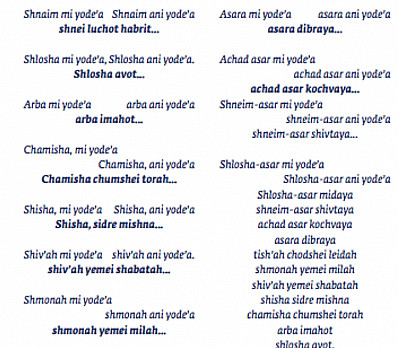
"Echad Mi Yodea" is a cumulative song, meaning that each verse is built on top of the previous verses. There are thirteen verses.
The first verse runs:
- Who knows one?
- I know one.
- One is our God, in heaven and on earth.
The second verse:
- Who knows two?
- I know two.
- Two are the tablets of the covenant;
- One is our God, in heaven and on earth.
...and so forth. The last verse is:
- Who knows thirteen?
- I know thirteen.
- Thirteen are God's principles;
- Twelve are the tribes of Israel;
- Eleven are the stars of Joseph's dream;
- Ten are the Commandments;
- Nine are the months of childbirth;
- Eight are the days before circumcision;
- Seven are the days of the week;
- Six are the sections of the Mishnah;
- Five are the books of the Torah;
- Four are the Matriarchs;
- Three are the Patriarchs;
- Two are the tablets of the covenant;
- One is our God, in heaven and on earth.
Yiddish version
Spanish version
Showing the last complete paragraph, as an example. First and Last verses would be sung in Hebrew.
Judaeo-Ladino version
Judaeo-Arabic version
According to the custom of Aram Soba, Aleppo:
- Transliteration
- Translation
Judaeo-Tajik or Bokharian version
Lishan Didan version
...
Popular culture
The song appears in The Garden of the Finzi-Continis (film) 1970 movie, sung amidst the rise of Mussolini's racial laws and alignment with Nazi Germany.
The Judaism section of the Stack Exchange Network of question-and-answer websites is named Mi Yodeya after this song.
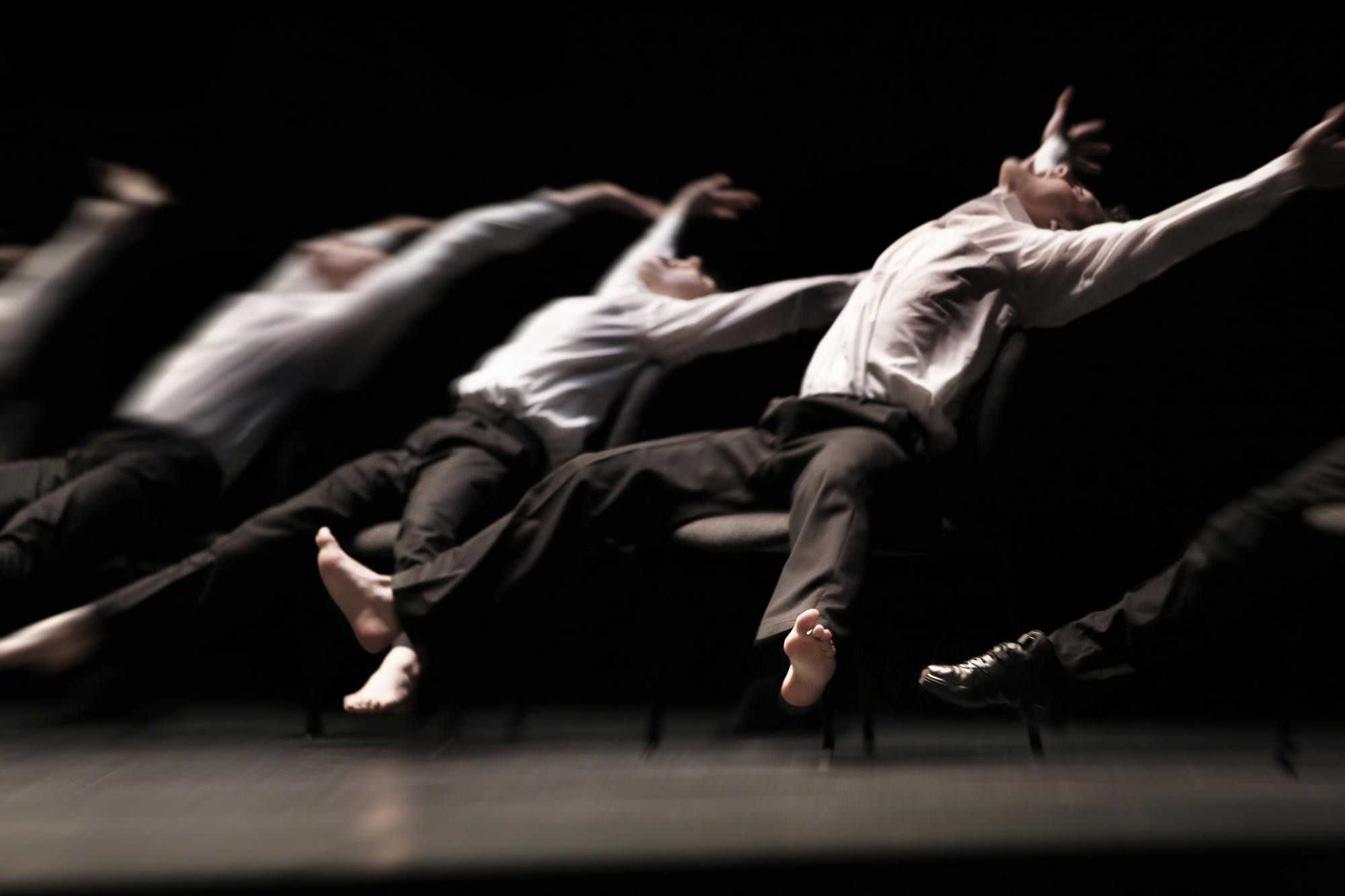
Entebbe (titled 7 Days in Entebbe in the U.S.), a 2018 crime thriller film directed by José Padilha and written by Gregory Burke, features a dance on the tunes of the Echad Mi Yodea song, choreographed by Ohad Naharin of the Batsheva dance company.
During an episode of the interactive cartoon "Charlie Gets Fired", the user has the chance for Charlie to sing the whole song. This much chagrin to his boss.
See also
- Green Grow the Rushes, O
References
External links
- Listen to Echad Mi Yodea online
- Listen & watch Echad Mi Yodea video with Hebrew lyrics and English translation